Linocut Tools: What Beginners Need and What Can Wait
For carving, one handle with a V and a U blade is enough. Add a soft block, a bench hook, a soft brayer, water-soluble ink and a spoon, plus paper, gloves and a smooth sheet from home. What fits with what, dated budgets, upgrades and what can wait.
By Lionel Rutledge ·
On this page
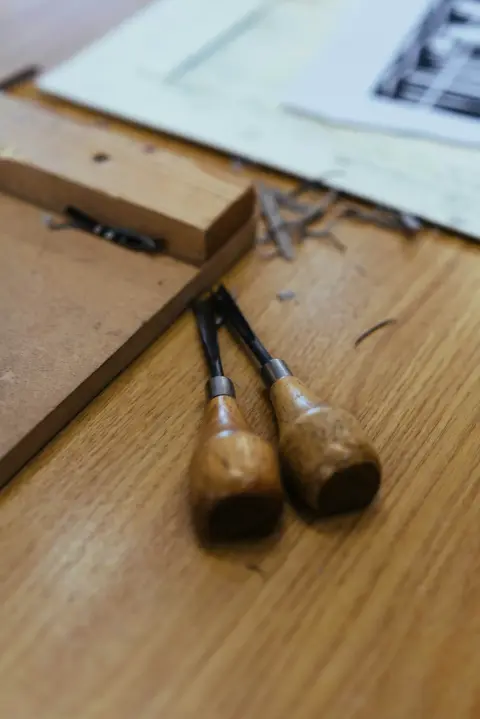
For carving, a beginner needs one linocut tool: a handle with a small V and a large U blade. A first print adds a soft block, a bench hook, a soft rubber brayer, water-soluble ink and a spoon, plus paper, gloves and a smooth sheet from home. The rest can wait.
At the maker's own store, Speedball's starter kit covers the cutter, the block, the brayer and the ink for $39.58 (13 Nov 2026). It leaves out the bench hook, the spoon, paper, gloves and a smooth sheet.
This page is the shopping half of the linocut for beginners guide, part of our printmaking lessons. That guide carves and prints one small practice block, the Four-Square Proof. Here you pick the tools for it, check what fits with what, and keep the rest of your money for later.
Need now, can wait
Buy for one small block, not for a studio. The left column is the whole first-print kit; the right column is what you skip until a print tells you otherwise.
Scroll sideways for all 3 columns.
| Need now | Cheap stand-in | Can wait, until… |
|---|---|---|
| Cutter handle with a V and a U blade | – | More blade shapes: when a mark you want is missing |
| Soft block, about 4 x 4 in (10 x 10 cm) | Cut a 4 x 6 in block down | Traditional lino: when you move on to finished, detailed work |
| Bench hook | A home-made wooden one | A metal bench hook: when the wooden one wobbles |
| Soft rubber brayer, 4 in | – | A wider brayer: when your block gets wider than 4 in |
| Water-soluble block printing ink, black | – | Oil-based ink, colours: after your first clean proof |
| Something smooth to roll ink on | A sheet of glass or smooth plastic | – |
| A wooden spoon | – | A baren: when you print a lot of cards |
| Newsprint and smooth light paper | Printer paper for proofs | Japanese paper, a press: much later |
| Gloves, soap, kitchen paper | – | – |
Gloves are on the list for the ink. The beginner guide covers them in its ink step; check the safety sheet of the ink you actually buy.
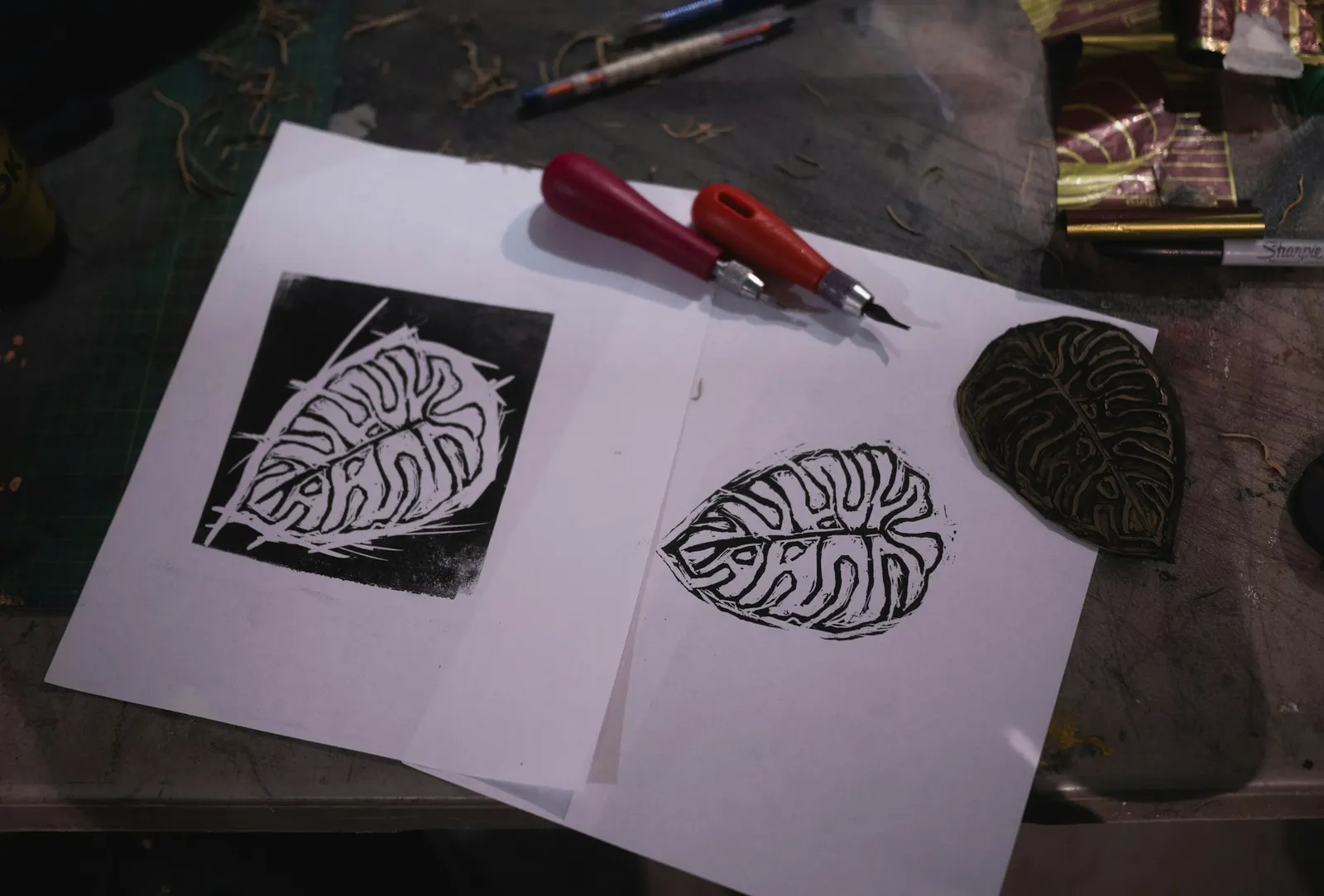
Cutters: one handle, a V and a U
Get one handle with swappable blades, plus a small V and a large U. Hickman Design sums up the jobs. "V-shaped gouges are great for fine lines and detail, U-shaped gouges remove larger areas". Knife blades are for straight lines and clearing corners. The same guide calls the larger interchangeable-blade tools "great for beginners".
Cutters come with three kinds of handle. A swappable-blade handle holds one blade at a time, like Speedball's or Flexcut's quick-connect handle. A palm handle sits in your palm with one fixed blade per tool, like Pfeil's. Long handles are the Japanese style; Boarding All Rows notes you can cut a Josei tool's "long wooden handle to fit the size of your hand". The choice is mostly about how the tool sits in your hand. A swappable-blade handle is the cheap way to learn which shapes you actually use.
Speedball, a US maker, numbers its lino cutters in six styles. Boarding All Rows lists them by number:
Scroll sideways for all 3 columns.
| No. | Shape | Use on a first block |
|---|---|---|
| 1 | Small V | Outlines, fine lines |
| 2 | Large V | Bolder lines |
| 3 | Small U | Small clearing, rounded lines |
| 4 | Square U | Flat-bottomed channels (can wait) |
| 5 | Large U | Clearing big white areas |
| 6 | Knife | Straight cuts, corners (can wait) |
The starter kit comes with #1, #2 and #5. That is a V for detail, a V for bolder lines and a U for clearing, which is all the practice block asks for.
A 12-piece set mostly buys you a drawer of gouges you meet once.
Replace or sharpen? It depends on the tool system. Speedball sells its cutters in pairs for $4.95 (about $2.48 a blade, 13 Nov 2026), so a dull blade is cheap to swap. Boarding All Rows' author says he sharpens his Speedball blades many times before recycling them, so sharpening is possible, just not required. Pricier tools are a different deal. Flexcut says its tools come "pre-sharpened at the factory" and need "periodically stropping" with a strop and polishing compound. It says sharpening stones should not be used for this routine care. Other upgrade tools do need a stone: more on that below.
A small saver: if the metal chuck that grips the blade goes missing, Speedball sells a 3-piece replacement chuck set for $4.36. The handle itself has a screw-off end that stores the blades, per the handle page.
Planning woodcuts too? Speedball describes these cutters as made for "soft or linoleum blocks". For wood, look at tools sold for wood.
When you outgrow the starter handle
Upgrade when a limit shows up: blades dull quickly, your hand cramps on the plastic handle, or fine lines tear instead of cutting cleanly. Three tool lines come up again and again for that step. None of them was tested by us.
- Power Grip (Mikisyo, Japan). Boarding All Rows calls them "a step up in quality over the Speedball Linoleum Cutter" with "sharpenable steel blades". The catch: they "must be sharpened with a water stone, honing block and honing compound". We could not find a current maker price, so check a dealer before you budget for them.
- Flexcut. Swappable blades on a quick-connect handle. The SK130 printmaking set (4 blades, handle, tool roll, strop and compound) was $72.95 at Flexcut on 13 Nov 2026, listed out of stock. Care is stropping, which the set includes.
- Pfeil (Switzerland). Palm tools, one shape each. Pfeil's own site shows no prices; it lists about 100 sales partners instead, so the price depends on the dealer. Read the width, not just the number. The six-tool lino Set C, as listed by the retailer Woodworker Specialties, runs from an 11 x 0.5 mm veiner to an 8 x 7 mm gouge. Its V tools are 2 mm and 4 mm.
Buying a cheap no-name kit instead? Check three things before you pay: the blades are sold separately, the handle grips them with a metal chuck, and the kit has a small V and a U. Boarding All Rows warns that some shop-brand copies of the Speedball cutter "are of inferior quality".
Blocks: start soft, then check the ink line
Start with a soft block. Hickman Design says traditional lino "can be quite tough to carve for beginners", while soft-cut is "significantly easier to carve".
Then read one line on the label: which ink the block takes. Not every soft block takes every ink. Speedball's own product pages are clear about theirs:
- Speedy-Carve: "Great for use with either water-soluble or oil-based block printing inks." It "can be cut into pieces". So one 4 x 6 in block gives you a 4 x 4 in practice square and a 4 x 2 in test strip.
- Speedy-Cut and Speedy-Cut Easy: "suitable for use with water-soluble block printing inks only." Fine for a first print, a dead end if you plan oil-based ink.
- Traditional linoleum, 1/8 in (0.3 cm) thick: "suitable for printing with any water-soluble or oil-based relief ink."
Brayer, ink and a surface to roll on
Get a 4 in soft rubber brayer and black water-soluble ink. Hickman Design's rule for size: "The width of the roller should match or exceed the width of your print." Overlapping passes can leave the ink uneven. A 4 in roller matches a 4 x 4 in block.
Soft or hard roller? A common shortcut says soft rollers are for water-based ink and hard rollers for oil-based ink. The maker's FAQ is broader. Speedball says soft rubber brayers "are best with water-soluble or oil-based printing inks" on lino, soft block or woodcut. Its hard rubber brayers are "ideal for use with water washable oil-based inks like Speedball fabric block printing inks". Hardness is really about the surface: softer rollers suit uneven surfaces, harder ones lay ink more evenly on smooth ones. For paper prints from a first block, soft is the safe pick.
A latex note. Speedball's soft rubber brayers are "natural latex gum rubber", per the product page. Its soft blocks are latex free, says the Speedy-Carve FAQ. The page for the kit's pop-in brayer does not use the word latex, but the soft rubber safety sheet linked from it lists natural rubber as the main component. If you react to latex, ask the maker before you buy.
Ink. Black shows every cut clearly. Speedball's black water-soluble ink comes in 1.25 fl oz up to 16 fl oz; the smallest size is the one in the starter kit. The same page answers two beginner questions. Clean-up: water-soluble ink washes off "with soap and water", while Speedball's oil-based inks "require solvent or vegetable oil". And do not thin it with water: "We do not recommend adding water to modify the inks."
The surface. You need a smooth sheet to roll the ink out on. Glass or smooth plastic works, as the beginner guide says. The metal plate in the next section does the same job.
The bench hook is not an extra
A bench hook holds the block still while you cut, so your free hand does not have to. Hickman Design says it "anchors the lino sheet to the edge of a workspace", and notes that most are "homemade" from wood or metal. Woodworker Specialties, which sells Pfeil cutters, recommends one too.
Speedball's Inking Plate & Bench Hook ($15.25, 13 Nov 2026) is a metal plate with a lip that hooks over the table edge. The maker says you can use it as a stop when carving "or use to roll out ink". One item, two jobs: holding the block and rolling the ink.
Speedball also sells Linozip cutters "with a unique safety design that reduces risk of cutting accidents", which it calls "great for classrooms and beginners". They do not replace the hand position the beginner guide sets out before the first cut.
What fits with what
Check these pairs before you mix brands or upgrade one part. Everything here comes from the makers' own pages, except the Pfeil row, which uses a dealer's guide. Where a maker says nothing, the table says so.
Scroll sideways for all 3 columns.
| If you have… | It works with | Watch out for |
|---|---|---|
| Speedball cutters #1–#6 | Speedball lino handles. The cutters are "manufactured specifically for use with Speedball Lino Handles" | Speedball does not say they fit any other brand's handle. Do not assume they do |
| Flexcut SK blades | Flexcut quick-connect handles. The SK100 handle "fits any unhandled SK tool" | Flexcut does not say SK blades fit other brands' handles |
| Pfeil palm tools | Nothing to swap. Woodworker Specialties describes a "palm handle" on each tool, one fixed blade per handle | One tool per shape. Pfeil numbers show the shape: #1 is flat, the curve deepens up to #11 (a full U), #12 to #16 are V tools |
| Speedy-Cut, Speedy-Cut Easy blocks | Water-soluble ink | "water-soluble block printing inks only" |
| Speedy-Carve block | Water-soluble or oil-based ink | Contains PVC, so Speedball advises against laser cutters |
| Traditional linoleum | Any water-soluble or oil-based relief ink | Harder to carve; see "Blocks" above |
| Soft rubber brayer | Lino, soft block or woodcut, with water-soluble or oil-based ink (Speedball FAQ) | Natural latex rubber on Speedball's soft brayers |
| Hard rubber brayer | Water-washable oil-based inks such as Speedball's fabric inks | Not needed for a first paper print |
| Water-soluble ink | Soap and water clean-up | Do not add water. Speedball advises against mixing its water-soluble and fabric inks |
| Oil-based ink | Solvent or vegetable oil clean-up (Speedball) | Read its safety sheet first. The beginner guide covers oily rags |
Three budgets, priced at the maker
These are priced examples from one maker's US web store, read on 13 Nov 2026, before tax and shipping. I used Speedball because it sells every part separately, publishes its prices and states fit and ink rules on each page. This is not a test or a ranking. Other brands make similar kits.
1. First block: $39.58. This is the Water-Soluble Block Printing Starter Kit. It holds a 4 in pop-in soft rubber brayer, 1.25 fl oz of black water-soluble ink and a red lino handle. It also holds cutters #1, #2 and #5 and one 4 x 6 in Speedy-Carve block. Add from home: a spoon, a glass or plastic sheet, newsprint, gloves, soap. A home-made wooden bench hook keeps the total where it is.
2. Comfortable start: $62.55. That is the kit ($39.58), the Inking Plate & Bench Hook ($15.25) and a second 4 x 6 in Speedy-Carve block ($7.72) for your own design after the practice block.
3. Later, one item at a time. Buy each only when its "until" from the first table happens.
Scroll sideways for all 3 columns.
| Item | Price (13 Nov 2026) | Buy it when… |
|---|---|---|
| Another cutter style, pair (e.g. #3 small U or #6 knife) | $4.95 | a mark you want is missing |
| Speedy-Carve 4 x 6 in, 6-pack | $26.99 (about $4.50 a block) | you carve regularly |
| Speedball Baren | $37.09 | a spoon tires your hand on a run of cards |
| Flexcut SK130 printmaking set: 4 blades, quick-connect handle, tool roll, strop and compound | $72.95 (listed out of stock at Flexcut that day) | you want sharper tools and will strop them |
Kit or loose parts? The kit wins on price. Bought one by one at the same store, a similar set costs $48.61. That is a handle ($7.58) and two pairs of cutters, small V and large U ($4.95 a pair). Then a 4 x 6 in Speedy-Carve block ($7.72), a 4 in pop-in soft brayer ($17.47) and 1.25 fl oz of black ink ($5.94). That is $9.03 more, though you get spare blades of two shapes instead of single blades of three.
Don't buy this yet
- A press. The beginner guide prints its practice block with a spoon. A baren is the hand tool printmakers use when they have no press.
- A 10- or 12-blade set. Two or three shapes carve the whole practice block.
- Sharpening stones, for now. You don't need one for Speedball blades you can swap for $2.48, and Flexcut says routine care is a strop, not a stone. A stone becomes part of the cost when you move to tools that are honed, such as Power Grip.
- Big blocks. A 4 x 4 in block shows every mistake at a small cost.
- Oil-based ink. It means solvent or vegetable oil clean-up and a safety sheet to read. Start with water-soluble.
- A hard rubber brayer. Speedball points it at fabric inks, not paper prints from a first block.
Your first job with the new tools
Cut the 4 x 6 in block into a 4 x 4 in square and a 4 x 2 in strip. The strip is your test strip: cut one short line with each blade you own, then ink it and pull a proof on newsprint. Now you know what mark each blade makes before it touches your real design. This is a suggested exercise, not a result we made.
Then carve the square as the Four-Square Proof in the beginner guide, which takes you from mirrored drawing to first print. If you later want a print to end up on something you use, the functional art guide shows routes from a print to a useful object.
Spotted a price that has changed or a claim that looks wrong? Tell us on the contact page and we will check it against the maker's page.