Crochet Stitches: The Six Basics, Their Symbols and US/UK Names
The six basic crochet stitches are the chain, slip stitch, single, half double, double and treble crochet. One table gives their heights, US and UK names, chart symbols and turning chains; then how to make each one, how to tell them apart, why rows grow or shrink, and eight stitches built from them.
By Lionel Rutledge ·
On this page
The six basic crochet stitches are the chain, slip stitch, single crochet, half double crochet, double crochet and treble crochet. They differ mainly in height. UK patterns use the same stitches under names one step up, so a UK double crochet is a US single crochet.
From shortest to tallest: slip stitch, single, half double, double, treble. The slip stitch adds almost no height, so single crochet is the shortest stitch that builds fabric. The chain is the base you start from. Each taller stitch starts with one more yarn over or finishes with one more pull-through.
This page is the stitch reference that goes with our guide to starting crochet, which covers the hook, the yarn and your first square. Here it is the stitches only: names, symbols, how each one is made, how to recognize it, and what goes wrong at the ends of rows. US terms come first throughout, UK names in brackets.
The six basic stitches at a glance
Learn the stitches in height order, shortest first. The names and abbreviations below are from the Craft Yarn Council's abbreviations list, the yarn-industry trade group behind the standard terms. The turning chains are from Lion Brand's turning chain glossary. The starting positions are from the Yarnspirations stitch tutorials.
Scroll sideways for all 7 columns.
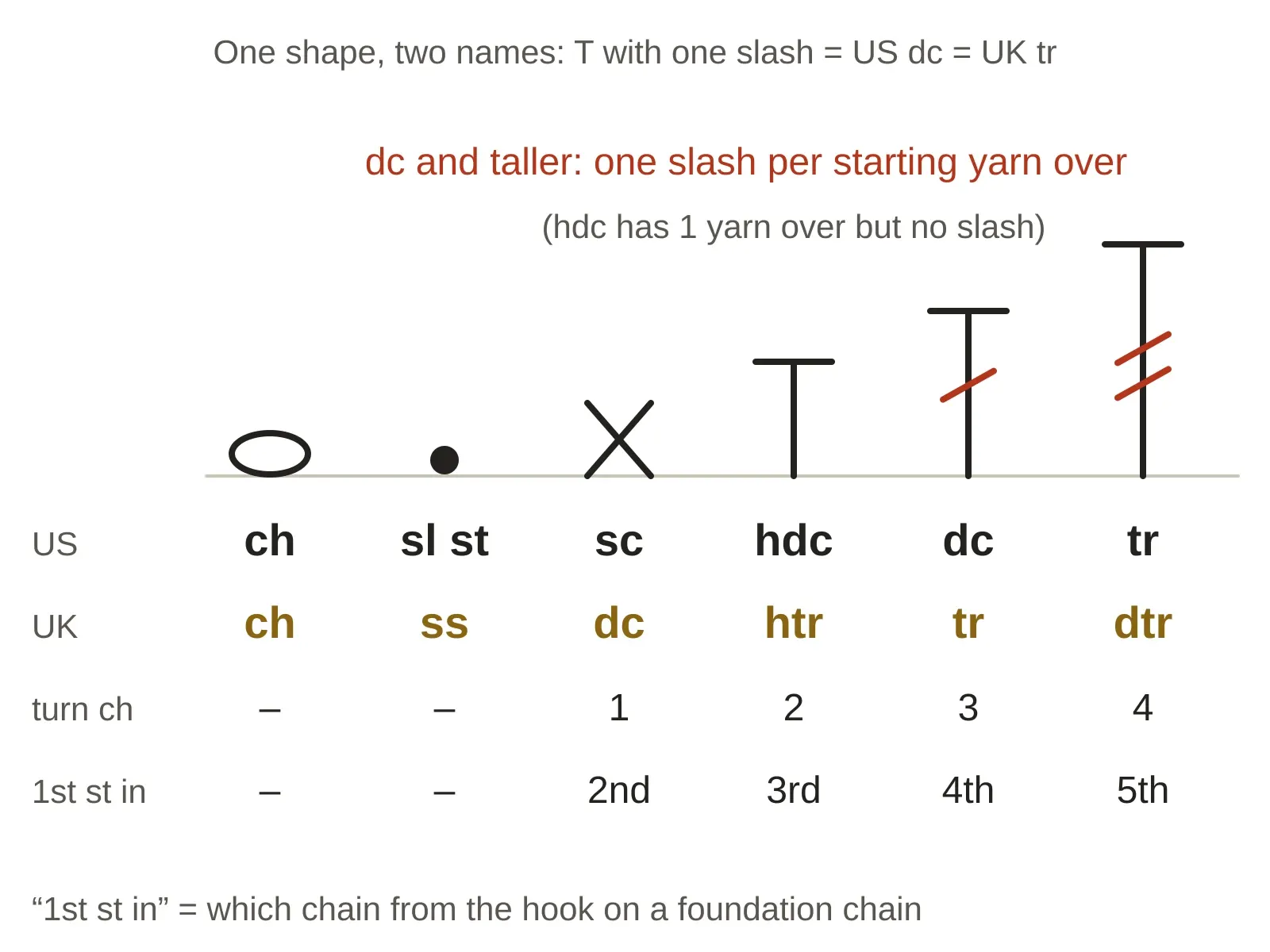
| US name (abbr.) | UK name (abbr.) | Height | Chart symbol | Yarn overs before the hook goes in | Turning chain | First stitch on a foundation chain |
|---|---|---|---|---|---|---|
| chain (ch) | chain (ch) | the base row | oval | – | – | – |
| slip stitch (sl st) | slip stitch (ss) | almost none | small dot | none | – | – |
| single crochet (sc) | double crochet (dc) | 1 (shortest fabric stitch) | x or + | none | 1 | 2nd chain from hook |
| half double crochet (hdc) | half treble (htr) | about 1½ | T | 1 | 2 | 3rd chain from hook |
| double crochet (dc) | treble (tr) | about 2 | T with one slash | 1 | 3 | 4th chain from hook |
| treble crochet (tr) | double treble (dtr) | a little over a double | T with two slashes | 2 | 4 | 5th chain from hook |
Heights are in single crochet rows, from Lion Brand's glossary wording (see the section on telling stitches apart).
The ladder keeps going. The next stitch up is the double treble (dtr), which the UK calls a triple treble (trtr). You will not need it in your first month.
Mind the clash in the middle of the table. "dc" means single crochet in a UK pattern and double crochet in a US one. "tr" is a double crochet in the UK and a treble in the US. If a pattern does not say which system it uses, the beginners guide has three quick tests for US or UK terms.
Symbols. Charts draw each stitch instead of naming it. Yarnspirations' guide to symbol charts describes the chain as "an oval", says "x or + symbol also means single crochet" and calls the half double a "T shape". The double gets one hatch line across the stem and the treble gets "two hatch lines representing the two 'yarn overs' that begin this stitch". The Craft Yarn Council publishes the standard set and adds: "Always refer to the pattern key for additional symbol definitions."
LoveCrafts points out that a symbol's height follows the stitch's height. It also says the x and the + are interchangeable single crochet symbols: "Diagrams will have one or the other, but not both in the same diagram". The same symbol is a double crochet in a UK key and a single crochet in a US one. The shape stays the same. The name in the key changes.
Six more abbreviations sit next to the stitch names in almost every pattern. All are from the Craft Yarn Council list.
Scroll sideways for all 2 columns.
| Abbreviation | Meaning |
|---|---|
| yo | yarn over |
| st | stitch |
| sp | space |
| tch or t-ch | turning chain |
| BLO | back loop only |
| FLO | front loop only |
How to make each stitch
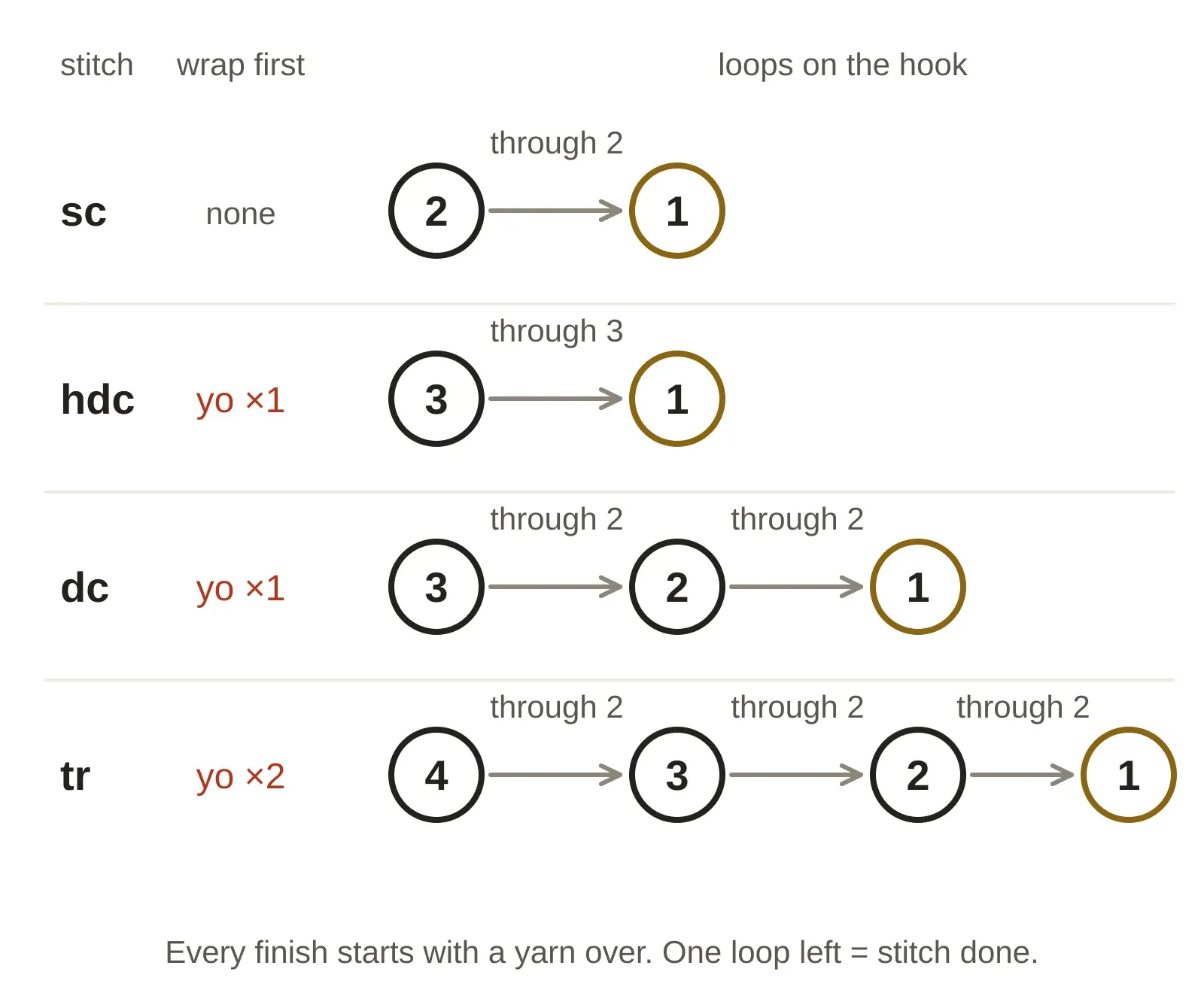
Every stitch uses the same few moves in a different mix. You wrap the yarn (or not), go into the stitch, pull up a loop, then work off the loops on the hook. In crochet, a stitch is one finished unit: you work it until one loop is left on the hook. When you count, Lion Brand's stitch guide leaves out the slip knot and the loop on the hook. The steps below follow Lion Brand, Yarnspirations and the Crochet Guild of America.
Chain (ch)
- Yarn over: take the yarn over the hook from back to front.
- Pull it through the loop on the hook. That is one chain.
Lion Brand gives the same two moves. The slip knot you start from, and how to count a chain, are in the beginners guide under make a chain and count it.
Slip stitch (sl st, UK ss)
- Insert the hook into the stitch.
- Yarn over and pull the yarn through the stitch and the loop on the hook in one go.
That is the whole stitch. The Crochet Guild of America (CGOA) describes the move as: "bring the yarn through both the chain and the loop that is on the hook."
Single crochet (sc, UK dc)
- Insert the hook into the 2nd chain from the hook (or the next stitch).
- Yarn over and pull up a loop. You have 2 loops on the hook.
- Yarn over and pull through both loops.
Yarnspirations calls it "the most common basic crochet stitch that will result in fabric".
Half double crochet (hdc, UK htr)
- Yarn over, then insert the hook into the 3rd chain from the hook.
- Yarn over and pull up a loop. You have 3 loops on the hook.
- Yarn over and pull through all three loops.
The single pull "through all three loops on the hook" is where it parts ways with the double (Yarnspirations).
Double crochet (dc, UK tr)
- Yarn over, then insert the hook into the 4th chain from the hook.
- Yarn over and pull up a loop. You have 3 loops on the hook.
- Yarn over and pull through the first two loops. You have 2 left.
- Yarn over and pull through the last two.
Same start as the half double, finished two loops at a time (Yarnspirations).
Treble crochet (tr, UK dtr)
- Yarn over twice, then insert the hook into the 5th chain from the hook.
- Yarn over and pull up a loop. You have 4 loops on the hook.
- Yarn over and pull through two loops. Do this three times in all, until one loop is left.
Yarnspirations adds that it is "sometimes called triple crochet". Lion Brand's glossary uses that name.
Stop here and check: count the loops on your hook after you pull up a loop. Two means single, three means half double or double, four means treble. If the number is wrong, the yarn over at the start went missing. Pull the stitch out and start it again.
How to tell them apart in your fabric
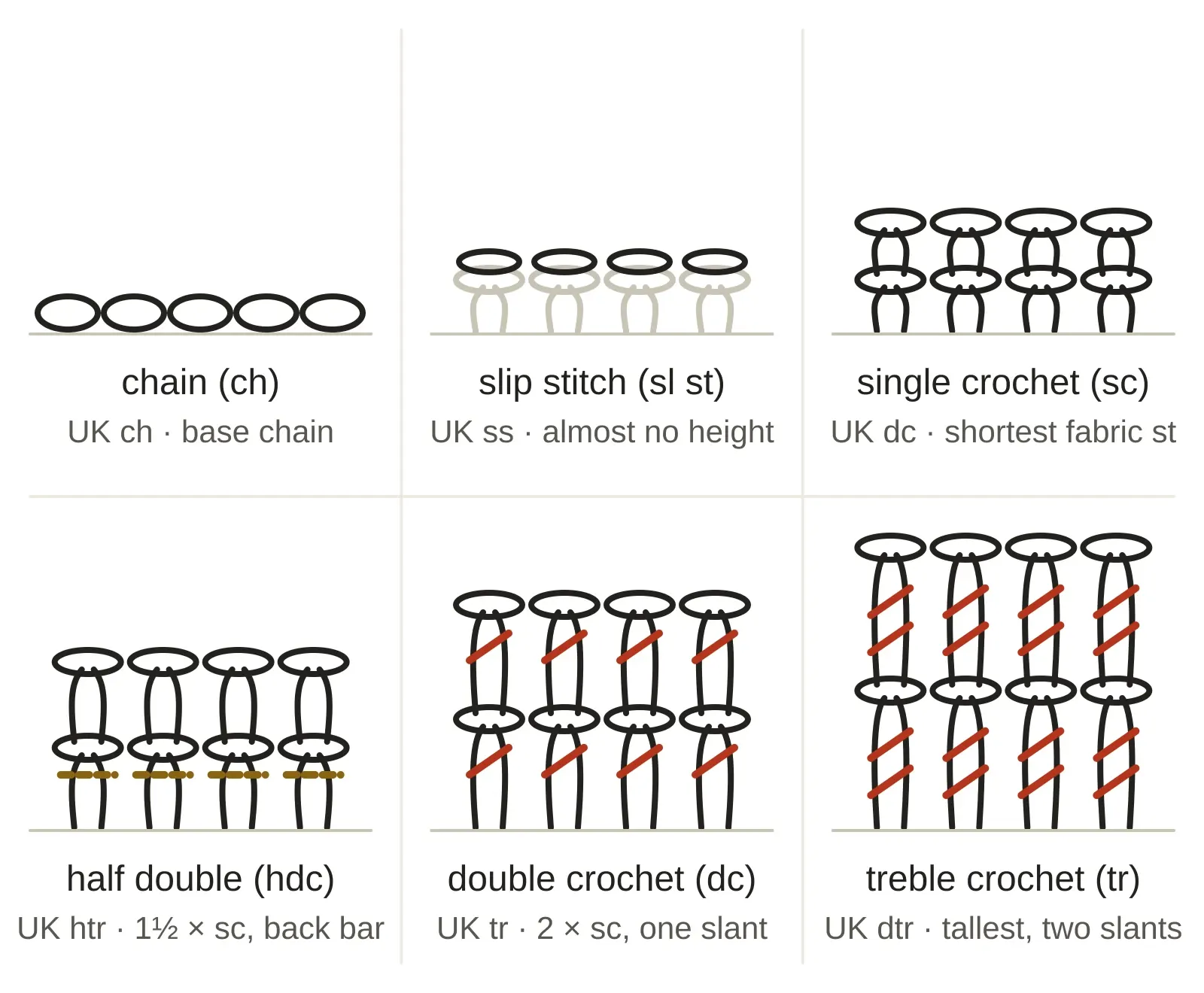
Look at the height first, then at the post. The post is the upright part of the stitch, below the two loops on top. Lion Brand's glossary gives the heights in plain words: the half double "comes halfway between a single crochet and a double crochet in height" (hdc). The double is "about twice the height of a single crochet" (dc). The treble is "a little taller than a double crochet" (tr).
Height is hard to judge on a single stitch, so use these clues as well:
- Count the slanted bars on the post (double and treble). On a double or treble, each yarn over made before the hook goes in stays on the post as a slanted bar. A double usually shows one, a treble two. The chart symbols mark these with hatch lines. A single crochet has no yarn over and no bar. The half double's yarn over is pulled off in one go with the other loops, so it leaves no slanted bar. Look for the bar on the back instead (next point); its symbol is a plain T.
- Look for the bar on a half double. The last step pulls through three loops, which leaves a third loop. Marly Bird's stitch anatomy guide describes it as "a horizontal bar on the back of half double crochet stitches". When you turn the work, those bars face you.
- Single crochet is short and close. The stitches sit tight against each other, with almost no gap between them.
- A slip stitch barely rises. It is a link, not a row-builder. The CGOA notes you would not normally make a whole item from slip stitches alone.
Every stitch has two loops on top, the front loop (nearer you) and the back loop. Lion Brand's stitch guide says you "usually" go under both loops of the stitch in the row below. A pattern tells you when to use only one, with BLO or FLO.
Starting chains and turning chains
The starting chain is the number of stitches you want plus the turning chain. If the turning chain counts as a stitch, take one off. The CGOA practice swatches, all 12 stitches wide, follow that rule exactly:
Scroll sideways for all 5 columns.
| Stitch | Turning chain | Does it count as a stitch? | Chains for 12 stitches | Source |
|---|---|---|---|---|
| single crochet | ch 1 | no | 13 | CGOA single crochet |
| half double | ch 2 | depends on the pattern | 14 if it does not count, 13 if it does | CGOA, Lion Brand |
| double crochet | ch 3 | yes | 14 | CGOA double crochet |
| treble crochet | ch 4 | yes | 15 | CGOA treble crochet |
Worked through for the double: 12 stitches + 3 turning chains = 15, minus 1 because the turning chain counts = 14. Lion Brand's glossary says the same thing in its own words: chain "2 chains more than the number of double crochet stitches called for".
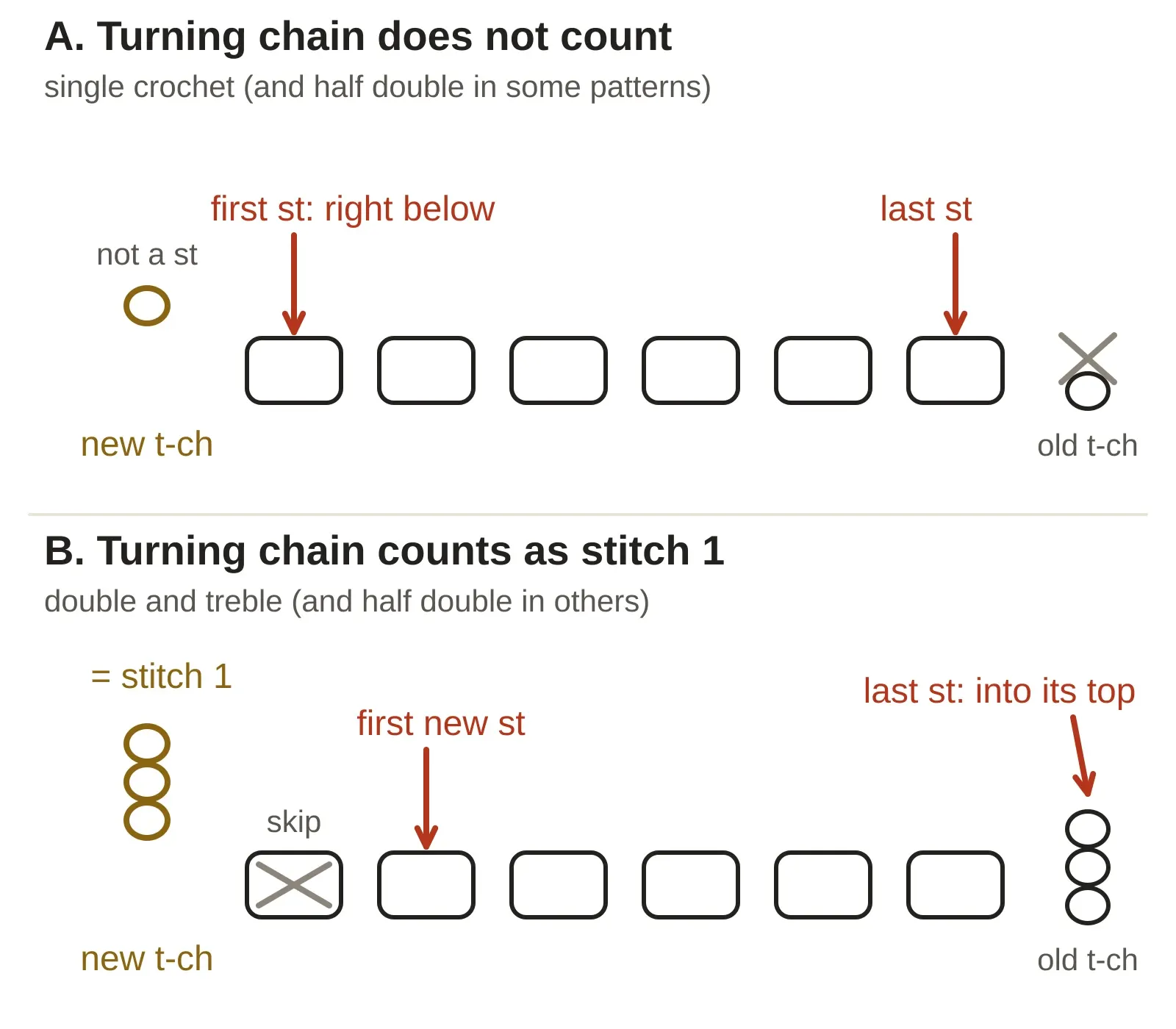
When the turning chain does not count (single crochet), the first stitch of the row goes into the stitch right below the chain. Lion Brand's glossary is clear on it. "The turning chain worked at the beginning of a single crochet row does not count as a stitch". At the far end, "You will not work in the turning chain on the return row".
When it counts (double and treble), the same glossary says the turning chain "usually" takes the place of the first stitch of the row. So you skip the stitch right below it. At the far end, the CGOA says: "The last stitch should be worked into the turning chain of the previous row".
The half double is where teachers disagree. The CGOA lesson starts 12 half doubles from 14 chains and tells you to "Ignore the chain 2 at the end". Lion Brand starts from one chain more than the stitches needed. On later rows it skips the first half double and works into "the top of the turning chain at the end of the row". Both keep the row at 12 stitches. Follow your pattern: if it says "ch 2 (counts as hdc)", use the second method. If the stitch count at the end of each row includes no turning chain, use the first.
When the rows go wrong
Most stitch trouble shows up at the ends of rows. Find the symptom, then check the turning chain before anything else.
Scroll sideways for all 3 columns.
| What you see | Likely cause | Fix |
|---|---|---|
| Double or treble rows lose one stitch each row | You skipped the turning chain at the end | Work the last stitch into the top of the old turning chain, as the CGOA lesson says |
| Double or treble rows gain one stitch each row | You worked into the stitch right below the new turning chain | Skip it. The turning chain already stands in for that stitch, per Lion Brand's glossary |
| Single crochet rows grow | You worked into the turning chain at the end | Leave it. In single crochet it is not a stitch |
| Single crochet rows shrink | You missed the first stitch, under the turning chain | Put the first stitch into the stitch right below the chain |
| Half double rows are off by one against the pattern | The pattern counts the turning chain differently from you | Read the pattern note ("counts as hdc" or not) and match its stitch count |
| Everything comes out taller than the photo | A UK pattern read in US terms: every UK name is one US stitch taller | Check which terms the pattern uses, then rework from the start |
| The first row is one stitch short | You counted the slip knot or the loop on the hook as a chain | Lion Brand: "do not include the slip knot at the end or the loop on your hook as a stitch" |
Stop here and check: count the stitches at the end of every row for the first few rows. A wrong count in row 2 is a one-row fix. In row 20 it is an evening.
Stitches built from these six
Many textured and lacy stitches are the basics grouped, spaced out or worked around a post. You do not need new hand moves, only new places to put the hook. Here are eight you will meet often. The abbreviations are from the Craft Yarn Council list, and the Council's chart key has a symbol for most of them.
Scroll sideways for all 3 columns.
| Stitch (abbr.) | Built from | Where you see it |
|---|---|---|
| moss stitch | sc, ch 1, skip 1; next rows put the sc into the ch-1 spaces (Mary Maxim) | garments, afghans, accessories (Mary Maxim's list) |
| V-stitch (V-st) | (dc, ch 1, dc) in the same stitch; next row's V goes into the ch-1 space (Lion Brand) | open, lacy rows |
| shell (sh) | several stitches in one stitch, not joined at the top; often 5 dc (Yarnspirations) | scalloped edges and rows; CYC symbol "5-dc shell" |
| front and back post double crochet (FPdc, BPdc) | a dc worked around the post of the stitch below, from the front or from the back (Lion Brand FPdc, BPdc) | raised texture; alternating the two makes ribbing |
| cluster (CL) | stitches left unfinished and joined at the end, each worked into a different stitch below (Yarnspirations) | CYC symbol "3-dc cluster" |
| bobble (bo) | unfinished stitches in the same stitch, the last loop of each left on the hook, all joined at the end (Yarnspirations) | bumps on a flat row |
| puff stitch (ps) | a bobble made with half doubles (Yarnspirations) | soft, rounded bumps |
| popcorn (pc) | finished stitches in one stitch, then the hook is taken out, put back into the first one and the loop pulled through to close the group (Yarnspirations) | a raised, closed bump; CYC symbol "5-dc popcorn" |
Bobble, puff and popcorn are easy to mix up. Yarnspirations' guide to stitch variations sorts them by one detail. A bobble leaves each stitch unfinished, a puff does the same with half doubles, and a popcorn finishes every stitch and then closes the group. The Craft Yarn Council's chart even gives one symbol for "3-hdc cluster/puff st/bobble", so read your pattern's key.
Which stitch for which job
Choose the stitch by the fabric you want. Short stitches make firm, close fabric; tall stitches grow faster and leave more space between posts.
- Slip stitch: joining, not building. The CGOA lists joining a chain into a ring, joining rounds, seams and finishing an edge.
- Single crochet: firm and close. We would use it for anything that should hold its shape: a coaster, a pouch, a basket base.
- Half double: a middle ground, between single and double crochet in height. Yarnspirations suggests it for blankets and scarves.
- Double crochet: about twice as tall per row as single crochet, so a piece grows quickly. We would pick it for a shawl that should drape.
- Treble crochet: the tallest of the six. We would use it for lacy, airy rows rather than anything that has to be sturdy.
Best stitch for a blanket? We would start with half double, double crochet or V-stitch: they grow quickly and drape. A whole blanket in single crochet comes out firm and grows slowly.
For more things to make that you then use, see our other making guides.
Small exercise. Make three swatches, each 12 stitches wide, in the same yarn and hook: single crochet from 13 chains, half double from 14, double from 14. Work each until it is about as tall as it is wide, then lay them side by side. Count the rows each one needed. That number is your own height comparison, measured in your yarn and your tension. If you have not made the single crochet square yet, the 12-stitch square in our crochet for beginners guide walks through it row by row.