Easy Drawing Ideas for Beginners: 24 Prompts by Level and Time
24 easy drawing ideas you can start with one pencil. Pick by the minutes you have and how hard you want it, then follow the first shapes we give.
By Lionel Rutledge ·
On this page
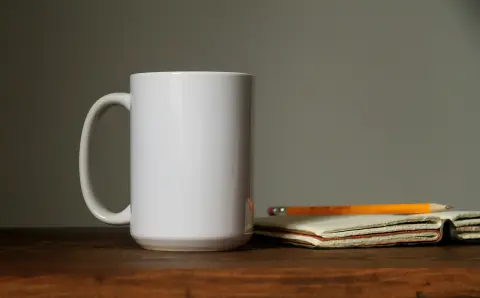
These 24 easy drawing ideas need one pencil and 5, 15 or 30 minutes. Pick a prompt by the time you have and how hard you want it, draw the first shapes it names, and stop when the timer rings. No time to choose? Draw prompt 1, a mug, in five minutes.
The prompts suit adult and teen beginners. Drawing with a child? Level 1 prompts 1, 6, 7, 12 and 22, and the cute versions further down, are the easiest to share. Every prompt, level and time is our own suggestion. We have not drawn and timed each one, so treat the minutes as a rough guide. If you want a full practice order rather than single ideas, the 8-week plan for drawing beginners uses these prompts in week 8.
Which prompt fits your time?
Find your time in the left column and your mood along the top. The numbers point to the tables further down.
Scroll sideways for all 4 columns.
| Time | Level 1: one or two shapes | Level 2: several shapes in proportion | Level 3: shading, texture or perspective |
|---|---|---|---|
| 5 min | 1 mug, 2 pebble, 6 leaf, 7 mushroom, 12 fish, 17 spoon, 18 hand, 22 sea | 8 branch, 13 sleeping dog | none: too little time |
| 15 min | 3 cup from four sides, 19 pattern strip | 9 succulent, 14 cat, 15 bird, 20 icon grid, 23 mountains | 10 houseplant |
| 30 min | two 5-minute prompts plus 3 or 19 | 4 shoe | 5 lamp, 11 sunflower, 16 owl, 21 dotted ball, 24 street corner |
Two cells have no prompt of their own on purpose. Level 3 needs more than five minutes. Thirty minutes on one simple shape gets fussy, so use the time for two 5-minute prompts and one 15-minute one.
Bored and can't choose? Use today's date. The 7th means prompt 7; after the 24th, subtract 24. On the 30th you draw prompt 6, a leaf.
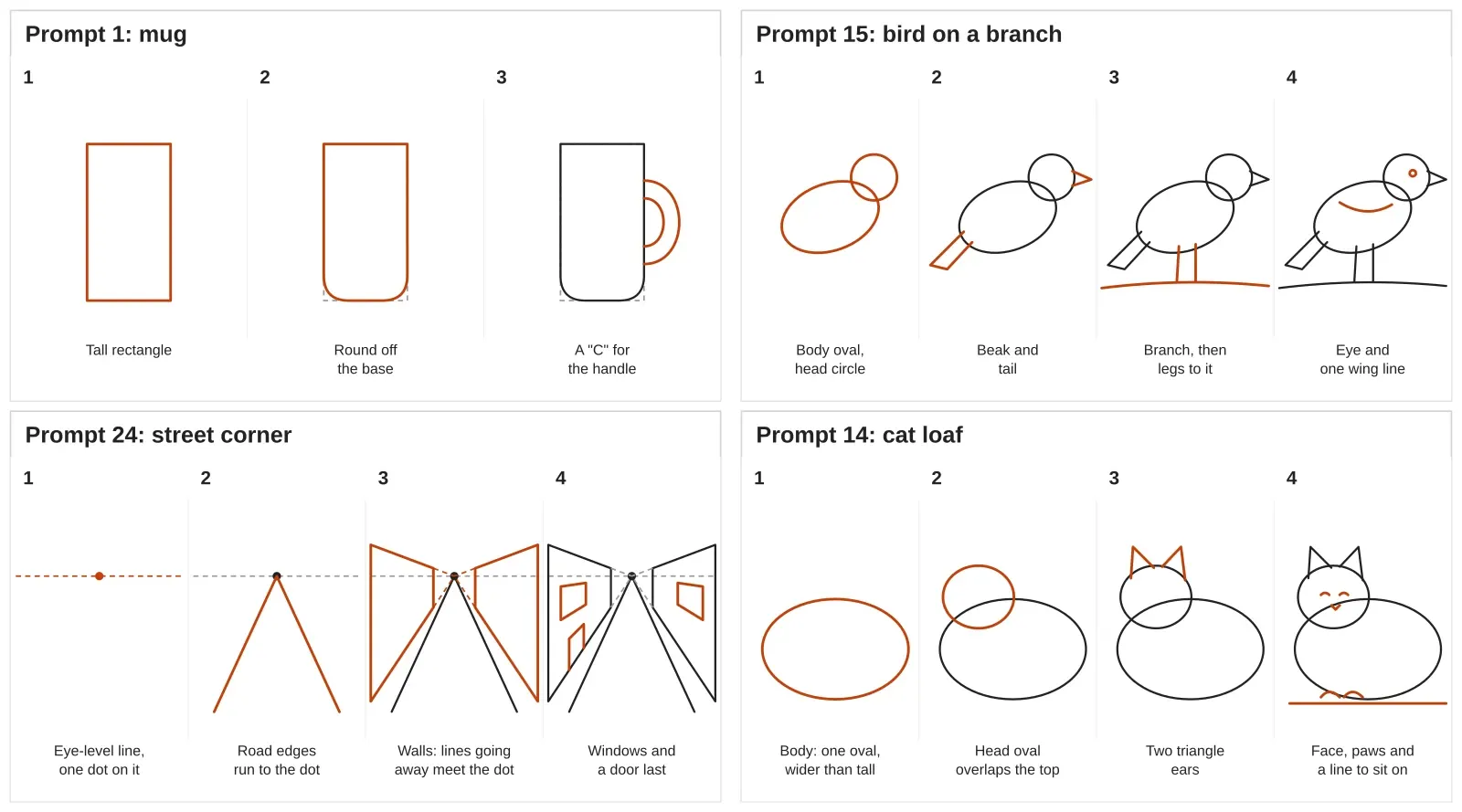
The diagram sheet below shows the first shapes of four prompts: 1, 15, 24 and 14. The new step in each panel is orange.
What do the levels mean?
A level counts shapes and hard skills, not talent. This rule keeps the labels honest.
- Level 1: one or two main shapes or a line exercise, plus small extras such as an eye or a handle. A flat shadow shape is fine; no gradual shading.
- Level 2: three or more shapes that overlap or must sit in proportion. Light, flat shading is fine.
- Level 3: one hard thing on top: shading a curved form, a texture that fills a form, or lines that meet at one point.
Move up a level when three tries of the same prompt finish inside the time. A wobbly first try is normal and tells you nothing yet.
What goes on the table?
A pencil, cheap paper, an eraser and a timer. Your phone's timer is fine.
- Pencil: an HB or a 2B. Any school pencil will do for a first week.
- Paper: printer paper. A sketchbook only helps because it keeps your tries in one place.
- Pen or felt-tip (optional): fine for any level 1 or 2 prompt, and the best choice for 17, 18 and 20, where you should not erase anyway.
Don't buy yet: blending stumps, markers, coloured pencil sets. Buy one when a prompt shows you a real need.
The 24 prompts
Each row tells you what to draw, the shapes to start with, the skill it trains and the week of the 8-week plan it pairs with. Draw from a real object whenever the prompt allows. A real mug shows you how it sits in space; a photo has already flattened it for you.
For animals and flowers you cannot put on the table, use your own photo. A free photo also works: the Unsplash licence says its images "can be downloaded and used for free", with "No permission needed (though attribution is appreciated!)". That covers the free photos only: images marked Unsplash+ come with a paid subscription and a separate licence.
Things on your table
Scroll sideways for all 6 columns.
| # | Prompt and first shapes | Level | Time | Trains | Plan week |
|---|---|---|---|---|---|
| 1 | A mug from the side. A tall rectangle, a rounded base, a "C" for the handle. | 1 | 5 min | Curves on a simple block | 3 |
| 2 | A real pebble. Draw its oval, then the shadow it throws on the table. | 1 | 5 min | Seeing one form and its cast shadow | 5 |
| 3 | One cup from four sides: from above, eye level, a bit higher, a bit lower. | 1 | 15 min | How a circle turns into an ellipse | 3 |
| 4 | One of your shoes from the side. Sole first, then heel, then the top and laces. | 2 | 30 min | Proportion of one part to another | 4 |
| 5 | A desk lamp. A base, a tilted arm and a shade, then shade the inside of the shade. | 3 | 30 min | Angled forms and tone on a curve | 5–6 |
A mug is the most patient model you will ever have. It never fidgets and it does not mind a second attempt.
On prompt 2, keep your darkest mark for the shadow on the table, right where the pebble touches it. The pebble's own shadow side stays a step lighter. The University of Delaware's value notes say it plainly for a ball: "the darkest dark in the drawing of the sphere occurs in the cast shadow".
Plants
Scroll sideways for all 6 columns.
| # | Prompt and first shapes | Level | Time | Trains | Plan week |
|---|---|---|---|---|---|
| 6 | One leaf: a pointed oval, a centre vein, two side veins on each side. | 1 | 5 min | Steady, light lines | 1 |
| 7 | A mushroom: a half circle on a short block, a ground line below. | 1 | 5 min | Joining two shapes | 3 |
| 8 | A quick branch with five leaves of different sizes, all pointing different ways. | 2 | 5 min | Size and angle at speed | 1, 4 |
| 9 | A potted succulent. The pot first, then fat petal shapes layered from the centre out. | 2 | 15 min | Layering front over back | 3–4 |
| 10 | A houseplant in its pot. Keep it simple and shade only the pot, darker on the side away from the window. | 3 | 15 min | Light direction on a cylinder | 5 |
| 11 | A sunflower head from the front. A centre circle, a ring of petals, crossing curves for the seeds. | 3 | 30 min | Repeated pattern and even spacing | 6 |
Animals
Scroll sideways for all 6 columns.
| # | Prompt and first shapes | Level | Time | Trains | Plan week |
|---|---|---|---|---|---|
| 12 | A fish from the side: an oval, a triangle tail, a dot for the eye. | 1 | 5 min | Simplifying a form | 3 |
| 13 | A dog asleep and curled up. One big curve for the whole body first, then ears and nose. | 2 | 5 min | Seeing a pose as one shape | 3 |
| 14 | A cat sitting like a loaf: a big oval body, a smaller oval head, two triangle ears. | 2 | 15 min | Building a figure from ovals | 3–4 |
| 15 | A bird on a branch. Two ovals for body and head, then the tail, beak and feet. | 2 | 15 min | Putting parts in proportion | 4 |
| 16 | An owl. Body and head as one egg shape, feathers as rows of small U marks. | 3 | 30 min | Texture by repetition | 6 |
Want it cute?
The simplest prompts turn cute with one rule: a big head, a small body, and dot eyes set low on the face. Add a small curve for a smile. Four that work well:
Scroll sideways for all 2 columns.
| # | Cute version |
|---|---|
| 1 | Give the mug a face: two dots and a smile just below the middle, the handle as an ear or an arm. |
| 7 | Make the mushroom cap bigger than usual, put the face on the stem, add two tiny feet. |
| 12 | Round the fish into almost a circle, one big dot eye, a tiny tail. |
| 14 | Make the cat loaf's head as wide as its body, two dot eyes set low, or two small upside-down "U" shapes for happy closed eyes. |
These are the easiest ones to draw with children. A wobbly line looks fine on a cute face.
Lines and patterns
Scroll sideways for all 6 columns.
| # | Prompt and first shapes | Level | Time | Trains | Plan week |
|---|---|---|---|---|---|
| 17 | A real spoon in one continuous line, without lifting the pen. | 1 | 5 min | Looking more, correcting less | 2 |
| 18 | Your other hand as a blind contour: eyes on the hand, never on the paper. | 1 | 5 min | Eye and hand moving together | 2 |
| 19 | A pattern strip: one shape (a leaf, a triangle) repeated across the page, a little bigger each time. | 1 | 15 min | Rhythm and spacing | 1 |
| 20 | A 3 × 3 grid of tiny icons: sun, cup, leaf, key, star and four of your own. | 2 | 15 min | Quick, simple symbols | 3 |
| 21 | A ball made only of dots, packed closer on the shadow side. | 3 | 30 min | Light and dark without lines | 5 |
Prompts 17 and 18 are contour drawing. Britannica describes it as following an object's edge "in one continuous line to paper without looking down". The result will look odd, and that is fine. The point is the looking. When you want a hand that actually looks like a hand, move on to how to draw hands with simple shapes.
Places
Scroll sideways for all 6 columns.
| # | Prompt and first shapes | Level | Time | Trains | Plan week |
|---|---|---|---|---|---|
| 22 | A calm sea: one horizon line, a few short waves, maybe a boat. | 1 | 5 min | Placing the horizon | 1 |
| 23 | A mountain ridge in three layers. The back ridge lightest, the front ridge darkest. | 2 | 15 min | Depth through tone | 5 |
| 24 | A street corner: a road running away from you, a house on each side, lines meeting at one point. | 3 | 30 min | One-point perspective | 6 |
Prompt 23 borrows a painter's trick. The National Gallery's glossary on aerial perspective notes that as a landscape recedes "its colours and tones alter due to the nature of the atmosphere". In pencil, you can show that with a paler back ridge and a darker front one.
For prompt 24, draw a horizontal line at your eye level first and put one dot on it. The University of Delaware's perspective notes say lines parallel to the ground "converge at vanishing points on our eye level". So every roof line and kerb that runs away from you heads towards that dot.
How do you run one prompt?
Set a timer, draw big and light, check halfway, add detail last, then stop. The timer is the most useful tool here, because it stops you erasing the same line six times.
- Set the timer for the prompt's time.
- Draw the biggest shape first, lightly. Light means you can still see the paper through the line.
- Add the next shape against the first. Check where it starts and ends against what is already there.
- Stop at half time and check. Hold the page at arm's length. Fix sizes now, before any detail.
- Add detail in the last minute. Detail is the first thing to drop when time runs short.
- Stop when it rings. Write the date and prompt number in a corner.
Here is prompt 14, the cat loaf, as a 15-minute session.
- Draw one big, light oval for the body, wider than it is tall.
- Add a smaller oval for the head, overlapping the top front of the body.
- Put two triangle ears on the head.
- At about 7 minutes, hold the page away. Is the head too big for the body? Redraw it now.
- In the last minute, add the eyes, the nose and a short line for the front paws.
Stop here and check: the head and body overlap, and the cat sits on something. If it floats, draw a short shadow line under it.
What goes wrong, and how do you fix it?
Most bad sessions have a plain cause. Try the fix on the next prompt, not on the drawing you just finished.
Scroll sideways for all 3 columns.
| Symptom | Likely cause | Fix |
|---|---|---|
| The timer rang before the drawing was done | Details started too early | Big shapes until half time, details only in the last minute |
| You spent ten minutes choosing | Too many options | Use the date picker under the grid: today's date is the prompt number |
| It looks flat | Outlines only | Pick where the light comes from and add the cast shadow, as in prompt 2 |
| A copy from a photo looks stiff | You copied edges, not shapes | Draw the same subject as ovals and blocks first, or switch to a real object |
| Everything bunches at one edge | You started with a detail | Start with one light box around the whole subject |
For proportion and shading problems in general, the fix table in the 8-week plan goes deeper.
Your next small exercise
Do one level 1 prompt three times on the same page, then one prompt from the level above. Three tries of one thing make your progress easier to see than three different things once. Date the page, so you can compare it in a month.
Wondering who writes under the name Lionel Rutledge? How the Arte Funktional desk works explains it.